Knowing where to inject Ozempic is one of the most important things you can learn when starting this medication. Ozempic (semaglutide) is a once-weekly injectable prescription medicine used alongside diet and exercise to help manage blood sugar in adults with type 2 diabetes, and it is also widely used off-label for weight management. Getting the injection site right affects how well the drug is absorbed, how comfortable you feel, and how effectively you stick to your treatment over time.
This guide covers exactly where to inject Ozempic, which site works best, how to inject into the thigh, and the techniques that help you stay safe, comfortable, and on track with your health goals.
What Is Ozempic and How Is It Administered?
Ozempic is the brand name for semaglutide, a glucagon-like peptide-1 (GLP-1) receptor agonist. It works by enhancing glucose-dependent insulin secretion, slowing gastric emptying, and reducing appetite through interaction with GLP-1 receptors in the gastrointestinal tract, pancreas, and brain.
According to the FDA prescribing information for Ozempic, semaglutide is administered as a subcutaneous injection, meaning it goes just beneath the skin rather than into a vein or muscle. The drug is available in prefilled, multidose injection pens at doses of 0.25 mg, 0.5 mg, 1 mg, and 2 mg, and it is typically started at a low dose that is escalated gradually to minimize gastrointestinal side effects.
Subcutaneous semaglutide has a high bioavailability of approximately 89%, with peak concentration reached within one to three days. Steady-state drug levels are typically achieved after four to five weeks of weekly administration, according to StatPearls clinical data on semaglutide.
Where to Inject Ozempic: The Three Approved Sites
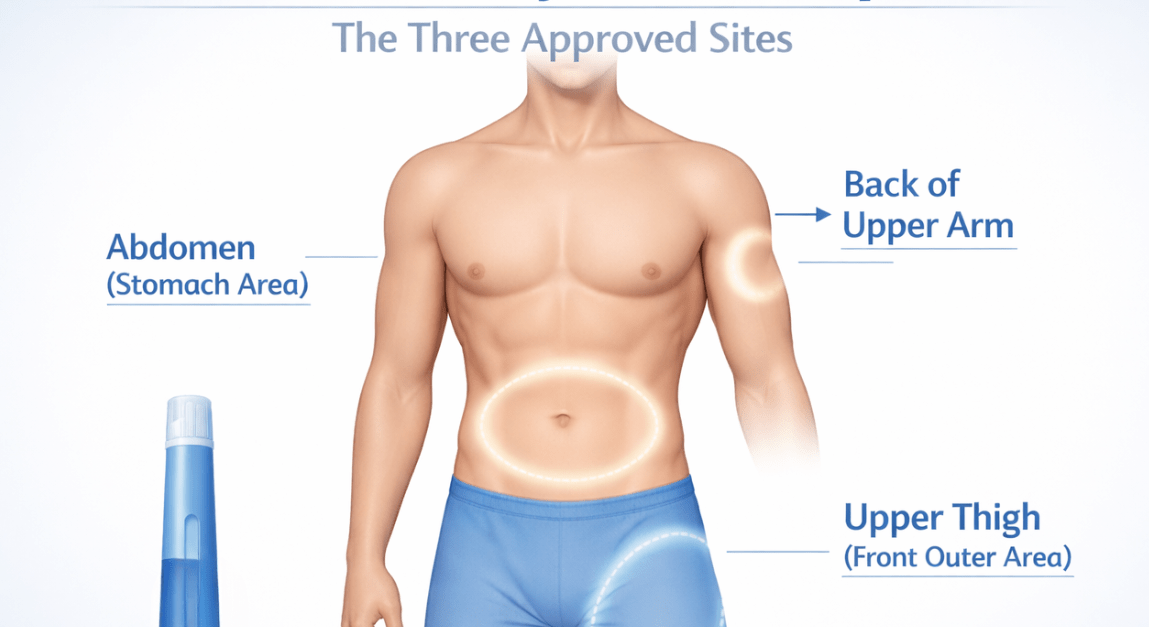
The official Ozempic pen instructions from Novo Nordisk confirm three injection sites for subcutaneous administration:
- Abdomen (stomach area)
- Upper thigh (front outer area)
- Back of the upper arm
According to Medical News Today, Ozempic should be injected just under the skin of these three areas, and you should rotate your injection spot with each dose, even if you prefer one area over others.
1. The Abdomen: The Most Recommended Site
The abdomen is the most commonly recommended site for Ozempic injections, and for good reason. It offers a large surface area with accessible subcutaneous fat, and clinical practice consistently shows it has the fastest and most reliable absorption of any approved site.
When injecting into the abdomen:
- Inject at least two inches away from the belly button in any direction
- Avoid the area directly around the navel, as well as any scars, bruises, or damaged skin
- Rotate within the abdomen by dividing it into quadrants and using a different spot each week
The abdomen’s advantages include easy self-access, good visibility during injection, and high drug absorption rates. The main downside is that repeated injections in the same spot can cause skin sensitivity or bruising, which is why site rotation matters so much.
2. Where to Inject Ozempic in the Thigh
A very common question is where to inject Ozempic in the thigh, and where in the thigh to inject Ozempic for the best results. The thigh is an excellent alternative to the abdomen and is preferred by many users for self-injection due to its accessibility.
According to Harley Street Skin Clinic, the correct thigh injection area is the outer front portion of the thigh, where there is enough subcutaneous (fatty) tissue beneath the skin. This area sits roughly halfway between the knee and the hip.
Where in the thigh to inject Ozempic:
- Use the outer front section of the upper thigh
- Avoid the inner thigh and the back of the leg
- Stay away from the knee and hip joints
- Pinch the skin slightly to lift it away from the muscle before inserting the needle
- Inject at a 90-degree angle for most people; if you are very lean, use a 45-degree angle to avoid hitting muscle
Important note: Some patients report mild discomfort when injecting into the thigh immediately after exercise, as increased blood flow and muscle tension can heighten sensitivity. It is best to rest your leg for a few minutes before injecting if you have been active.
Absorption from the thigh is slightly slower than from the abdomen, but it remains clinically effective at all approved sites.
3. The Upper Arm
The back of the upper arm is the third approved site. It is less commonly used for self-injection simply because it is harder to reach without assistance, but it is a valid and comfortable option if someone is helping you inject, or if you are using a mirror.
Technique for the upper arm:
- Target the fleshy, fatty area at the back of the upper arm, roughly midway between the shoulder and elbow
- Avoid the armpit and any area close to the elbow
- Do not inject near visible veins
The upper arm provides moderate absorption rates and is typically well-tolerated in terms of pain, making it a useful rotation option especially for people who prefer to alternate away from the abdomen and thigh.
Ozempic Injection Technique: Step-by-Step Guide
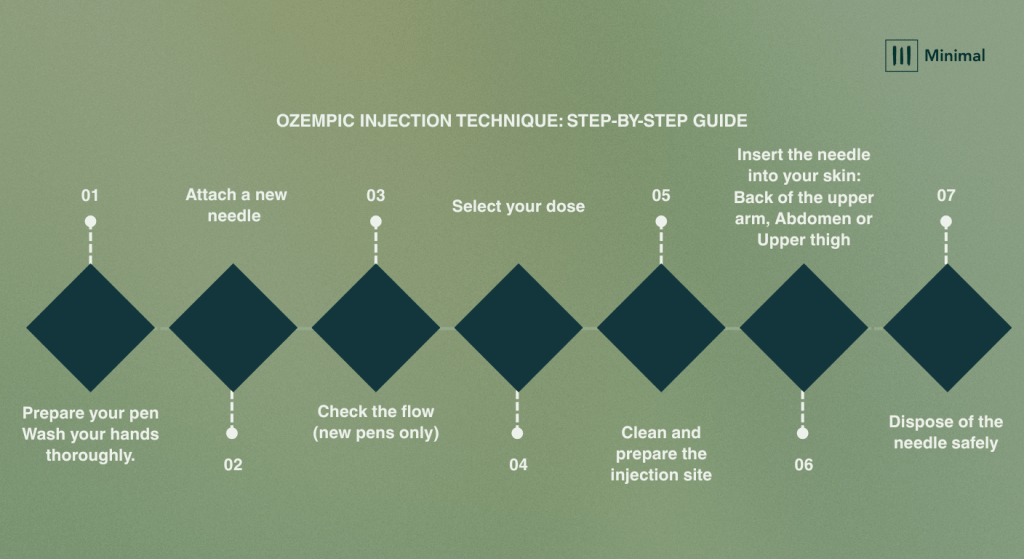
Following the correct injection technique is just as important as choosing the right site. Here is a step-by-step guide based on Novo Nordisk’s official instructions for use and Diabetes UK guidance on Ozempic:
Step 1: Prepare your pen Wash your hands thoroughly. Remove the pen cap and check that the medication in the window is clear and colorless. If it is cloudy or discolored, do not use that pen.
Step 2: Attach a new needle Always use a new needle for every injection. Pull off the paper tab, push the needle onto the pen, and twist until it is secure. Remove both the outer and inner needle caps.
Step 3: Check the flow (new pens only) Before your very first injection with a new pen, check the Ozempic flow by turning the dose selector to the flow check symbol, then pressing and holding the dose button until the counter shows zero. A small drop of medication should appear at the needle tip.
Step 4: Select your dose Turn the dose selector until the dose prescribed by your healthcare provider appears in the dose counter window.
Step 5: Clean and prepare the injection site Wipe the skin at your chosen injection site with an alcohol swab and allow it to dry completely before injecting. Injecting before the alcohol dries can cause a stinging sensation.
Step 6: Inject Insert the needle into your skin. Press and hold the dose button down until the counter shows zero. Continue holding down the button and count slowly to six before removing the needle. This ensures the full dose has been delivered.
Step 7: Dispose of the needle safely Carefully remove the needle and place it immediately into an FDA-approved sharps disposal container. Do not recap the needle. Replace the pen cap.
Why Rotating Injection Sites Matters
One of the most clinically important injection habits is site rotation. Injecting repeatedly into the exact same spot can lead to lipohypertrophy, a condition where fatty lumps develop under the skin at the injection site. These lumps can slow or impair drug absorption and cause discomfort.
As noted in the Boroughbury Medical Centre patient leaflet for Ozempic, patients should rotate injection sites with each injection. If injecting in the same general area (for example, always the abdomen), always choose a different spot within that area each week.
A practical rotation approach:
- Divide the abdomen into four quadrants (upper left, upper right, lower left, lower right) and cycle through them
- Alternate between the left and right thigh week by week
- Bring in the upper arm as a third rotation option to give other sites time to recover
- Avoid injecting into any area that appears red, bruised, scarred, or has any skin abnormality
Tips to Reduce Injection Discomfort
Injection discomfort with Ozempic is generally mild, but these tips can help minimize it:
- Let the alcohol dry first. Injecting before the swab has fully evaporated causes unnecessary stinging.
- Use a fresh needle every time. Needles become duller and more painful with reuse. The Ozempic pen comes with NovoFine Plus 32G needles, which are among the thinnest available.
- Inject at room temperature. Taking the pen out of the refrigerator and allowing it to reach room temperature for about 30 minutes before injecting can make the process more comfortable.
- Inject slowly and steadily. Pressing the dose button gradually and holding for a full six-count allows the medication to be delivered gently.
- Relax the muscle. Tension in the area being injected increases discomfort. For thigh injections, sit down and let your leg rest before injecting.
If you experience frequent injection site reactions such as redness, swelling, or itching, speak with your healthcare provider. These reactions are noted as possible adverse effects in the FDA label and research published in the Journal of the American College of Clinical Pharmacy.
Starting or Managing Your Ozempic Journey with Expert Support
If you are considering Ozempic or are already on the medication, having the right support structure makes all the difference. At Minimal, doctor-approved Ozempic programs are paired with personalized coaching, nutrition plans, fitness guidance, and regular check-ins to help you get the most from your treatment. Their care team supports you every step of the way, from your first injection to your long-term health goals.
Check your eligibility and get started with Minimal’s medical weight loss program today.
Absorption Rates and Effectiveness Across Injection Sites
All three FDA-approved injection sites for Ozempic are clinically effective. Research and clinical guidance confirm that semaglutide’s efficacy appears similar across sites, but there are practical differences to be aware of:
- Abdomen: Fastest and most consistent absorption. This site is often recommended as the primary choice, particularly for people new to injections.
- Thigh: Slightly slower absorption than the abdomen, but reliably effective. A good choice for rotation or when the abdomen site needs rest.
- Upper arm: Moderate absorption rate. Best used as a rotation option rather than a primary site, especially for solo injectors who find it harder to reach.
It is important to note that you should never inject Ozempic into a vein or directly into muscle tissue. The medication is specifically formulated for subcutaneous (under the skin) delivery, and injecting into the wrong layer can reduce effectiveness and increase the risk of complications.
What to Avoid When Injecting Ozempic
Certain practices can undermine both the safety and effectiveness of your injections. Here is what to avoid:
- Reusing needles. This raises the risk of infection, needle blockage, and medication leakage.
- Sharing your pen. Even with a new needle, sharing an Ozempic pen can transmit serious infections between people.
- Injecting into compromised skin. Areas with moles, visible veins, active rashes, scars, or bruising should be avoided.
- Injecting into muscle. The injection should always stay in the subcutaneous (fat) layer.
- Skipping site rotation. Repeatedly using the same spot can lead to lipohypertrophy and reduced drug absorption.
- Using a pen that has been frozen. Freezing damages the medication; Ozempic should be stored in the refrigerator (36 to 46 degrees Fahrenheit) before first use, then at room temperature for up to 56 days after first use.
Managing Side Effects Related to Injection
The most common side effects of Ozempic are gastrointestinal, including nausea, vomiting, diarrhea, and abdominal discomfort. These are generally not caused by the injection site itself but by the medication’s action on the gut.
However, injection-site-specific reactions can include localized redness, itching, bruising, or swelling. These are typically mild and resolve on their own, especially with proper rotation.
If you are experiencing nausea that is affecting your quality of life, you may find it helpful to read about how to stop nausea from Ozempic, which includes practical strategies for managing this common side effect.
In rare cases, individuals may experience more severe gastrointestinal complications. Learn more about Ozempic stomach paralysis (gastroparesis) and what to do if you notice symptoms of delayed gastric emptying.
Storing Your Ozempic Pen Correctly
Proper storage protects the medication’s effectiveness and ensures each dose is safe to use:
- Before first use: Store new, unused pens in the refrigerator at 36 to 46 degrees Fahrenheit (2 to 8 degrees Celsius).
- After first use: The pen can be kept at room temperature between 59 and 86 degrees Fahrenheit (15 to 30 degrees Celsius) for up to 56 days, or kept in the refrigerator within the same temperature range.
- Dispose of the pen after 56 days of first use, even if medication remains.
- Never freeze Ozempic. Frozen medication must be discarded.
- Keep away from heat and direct light.
When to Call Your Healthcare Provider
Contact your doctor or pharmacist if you notice any of the following:
- A lump or swelling in the neck (possible thyroid concern, as noted in Ozempic’s boxed warning)
- Severe or persistent abdominal pain (possible pancreatitis)
- Signs of a serious allergic reaction including swelling, difficulty breathing, or a severe rash
- Changes in vision
- Injection site reactions that do not improve with proper rotation
- Nausea, vomiting, or diarrhea that leads to dehydration
Ozempic carries a boxed warning about the potential risk of thyroid C-cell tumors based on animal studies. People with a personal or family history of medullary thyroid carcinoma (MTC) or Multiple Endocrine Neoplasia syndrome type 2 (MEN 2) should not use Ozempic.
Ready to Take the Next Step in Your Health Journey?
Finding the right support when starting a GLP-1 medication like Ozempic makes your experience much smoother. Minimal brings together doctor-led prescriptions, personalized fitness and nutrition plans, and an expert Care Team that supports your weight loss journey from day one. With programs available for Ozempic, compounded semaglutide, Wegovy, Mounjaro, and more, you can find a plan that fits your body and your life.
Explore Minimal’s weight loss program and check your eligibility today.
Frequently Asked Questions
1. Where is the best place to inject Ozempic?
The abdomen is generally considered the best place to inject Ozempic because it has the fastest and most consistent absorption, and it is easy to access for self-injection. However, the upper thigh and back of the upper arm are equally approved and effective sites. Rotating between all three areas is the ideal approach for long-term comfort and skin health.
2. Where to inject Ozempic in the thigh?
When injecting Ozempic in the thigh, aim for the outer front portion of the upper thigh, roughly midway between the knee and the hip. This area has sufficient subcutaneous fat for proper delivery. Avoid the inner thigh, back of the leg, and areas close to the knee or hip joint. Pinch the skin gently and inject at a 90-degree angle (or 45 degrees if you are very lean).
3. Does the injection site affect how well Ozempic works?
All three approved sites are clinically effective. The abdomen tends to offer the fastest absorption, while the thigh is slightly slower but still reliable. The difference is not significant enough to affect treatment outcomes when proper technique is used consistently. Rotating sites and maintaining consistent injection habits matter more than choosing one specific location.
4. Can I always inject Ozempic in the same spot?
No. You should rotate your injection site with every dose. Repeatedly injecting the same exact spot can cause lipohypertrophy, a condition where fatty lumps form under the skin, which can interfere with absorption. You can stay in the same general area (such as the abdomen each week) but always use a different spot within that area.
5. Is it safe to inject Ozempic in the thigh after exercise?
It is generally safe, but some people experience more sensitivity in the thigh after physical activity due to increased blood flow and muscle tension. To minimize discomfort, rest your leg for several minutes before injecting. If thigh injections consistently feel uncomfortable after exercise, switch to the abdomen or upper arm on workout days.
6. What should I do if I accidentally inject into muscle?
If you believe you have accidentally injected Ozempic into muscle rather than subcutaneous tissue, contact your healthcare provider. Intramuscular injection can affect how quickly the drug is absorbed and may cause localized pain or bruising. To prevent this from happening, always pinch the skin before injecting and use the correct angle (90 degrees for most people, 45 degrees for very lean individuals).